 Business · News 61
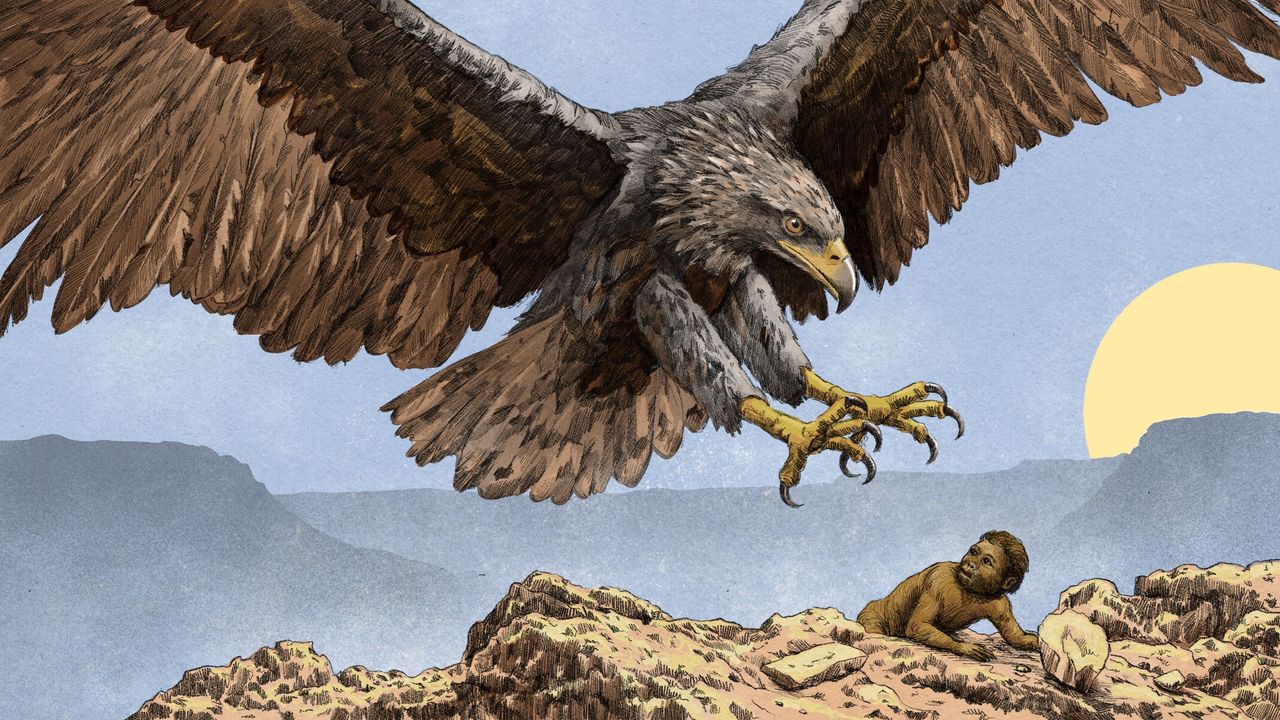
21 minutes ago Katherine Latham BBC/ Emmanuel Lafont (Credit: BBC/ Emmanuel Lafont) After the dinosaur-killing asteroid hit, giant birds became apex predators for tens of millions of years – and humans were among their prey. A child of our ancient ancestors, just three years old and still teething , wandered through the swaying grass of the South African savannah 2.8 million years ago. The young Australopithecus africanus was not aware it was being watched from above.
Warning: Some readers may find details in this story upsetting. The Stone Age was a perilous time to be alive. Megafauna came to rule the world .
Early humans lived alongside mammoths, mastodons, giant sloths, sabre-toothed cats – and huge child-eating birds. For tens of millions of years, between the fall of the non-avian dinosaurs and the Great Ice Age, the skies were ruled by these giants. Their reign may have shaped the course of human evolution in profound and overlooked ways.
Some are thought to have left their mark in legends of child-snatching birds that have lived on in cultures around the world, long after the birds themselves died out. Where the monstrous birds came from When the non-avian dinosaurs were wiped off the planet, the sky was blanketed in dust and most plants died out. For the animals, there was little to eat but seeds – but this suited birds just fine.
Some were plant-eaters , such as Australia's Dromornithidae, known as the "demon ducks of doom" – much like modern-day ducks but 100 times bigger and heavier than cows. Some took to the skies to become huge ocean-going predators , such as the largest known flying bird ever to live, the South Carolina Pelagornis sandersi , with its massive 7m (24ft) wingspan . Others, though, stepped into the roles left vacant by the extinction of top land-based predators like the Tyrannosaurs.
Where there's big prey available, even bigger predators evolve. These were the monstrous birds our ancestors had to contend with. BBC/ Emmanuel Lafont Some of the monstrous birds of the period were herbivorous, but not all (Credit: BBC/ Emmanuel Lafont) Modern and ancient clues "As long as primates have been around, there have been raptors," says Scott McGraw, a primatologist at Ohio State University, US.
"And raptors have always been preying on primates – including us and our relatives." Echoes of the ancient conflict between our ancestors and giant birds can be seen in the wild today. When McGraw examined the remains of more than 600 modern-day primates killed by birds of prey , including African crowned eagles, in Ivory Coast's Taï Forest, he discovered a remarkable similarity with the talon marks left on the Taung child's remains. In a number of skulls, the monkeys had damage to the orbital floor – a bony surface inside the eye socket – "where the eagle had either pecked out the eyes with its beak, or torn them out with a talon", says McGraw.
"One of our reviewers went down to the fossil vault, pulled out the Taung child, and found that the damage was identical." McGraw believes raptors would have routinely eaten our human ancestors – and that predation by birds may have been one of the most important selective forces in the evolution of primates, the order to which humans belong. "If we go back now and examine more closely the [human] fossil assemblages that have been collected over the years," he says, "there is a good chance – now that we know what we're looking for – we will find additional raptor damage. If what we're seeing in Taï is any indication, then this is normal." How predatory birds shaped our evolution There's little doubt in the paleoanthropological record that early humans were prey for a range of animals, says James Cole, archeologist and dean of applied sciences at Brighton University in the UK.
"Particularly the earlier hominins, like the baby Australopithecus africanus that was eaten by an eagle." Cole says our early ancestors were dinner for many predatory species. "We were predated upon for sure." When it comes to evading predatory birds, the larger the social group, the better, adds McGraw. Unlike pursuit predators – such as lions or wolves, which actively chase their prey, raptors are often ambush predators.
They are stealthy and, in the case of crowned eagles, hide in the trees until the moment is right. This indicates human tendency towards sociality may have been driven by the need to evade predatory birds in particular , so multiple pairs of eyes can keep watch for a surprise attack – known as the "many eyes effect" . Cole adds that larger group sizes may have also contributed to the emergence of language.
"[In a big group], you start to specialise roles. When you have some people doing one job while others are doing something else, that requires coordination. And once [a group] starts to fragment like that, coordination can't just rely on line of sight." For simple communication like hand gestures to work, people need to be able to see each other, says Cole, but when you have to coordinate beyond line of sight – say to warn of a predator approaching – "that's where language really starts to play a role".
The pressure to avoid death from above may have even kickstarted language evolution, McGraw suggests. Evidence shows most primates use generalised alarms for various predator types, the same call for a lion or a leopard, for example. But with raptors, they respond with specific calls.
Such signalling behaviour, McGraw suggests, could be interpreted as a precursor to human language . Natural History Museum of Los Angeles County 1981 Prehistoric birds, such as Argentavis, reached an immense size (Credit: Natural History Museum of Los Angeles County 1981) Meet the culprits: Eagles and teratorns The greatest crossover between giant predatory birds and our human ancestors is thought to have been in the Americas. Early Americans would have crossed paths with teratorns.
These were huge carnivorous birds that could swallow their prey whole . Soaring above the land, these condor-like birds boasted 6m (20ft) wingspans, and were both scavengers and predators . These birds were so huge, they could take to the air simply by opening their wings and getting an updraught, says Joanne Cooper, senior curator of the avian anatomical collections at London's Natural History Museum.
The Aiolornis incredibilis – also known as the incredible teratorn – terrorised southern California and Nevada and had a wingspan of up to 5.5m (18ft). Further north, in Oregon, the Teratornis woodburnensis had a 4m (14ft) wingspan. This monster of the skies lived about 12,000 years ago.
Its remains were found alongside those of mammoths, mastodons and ground sloths – as well as early humans . Haast's eagle was "essentially a flying tiger", says Cooper. It was roughly twice the weight of an adult harpy eagle , which is amongst the largest living eagles.
The Haast's eagle preyed on another giant, but ground-dwelling, bird, the 4m-tall (13ft) moa . The giant eagle would swoop down – its weight giving it considerable acceleration – and strike its prey on the back with its 10cm (4in) long talons, knocking it flat to the ground. "We see these huge talon marks on some moa pelvises," says Cooper, who notes the Haast's eagle would have been just as capable of attacking humans.
"Kids would have absolutely been at risk. It must have been awesome and terrifying." "When these birds fly over, they cast a shadow – and they cast a long shadow culturally all around the world," says Cooper. Child-hunting eagles Eagles hunting children may be more than just ancient history.
A news report from 19th-Century Tennessee tells of a child carried away by a "great grey eagle" after it swooped down and "fastened its immense talons in the clothing of the little boy". A servant girl gave chase as the bird flew away. Then, two miles away, the bird put its prey down momentarily.
A hunter who was nearby let out "vigorous hallooing", scaring the bird away. Thankfully, the "fine, healthy, rosy boy" was uninjured. How we outlived the giants In all, giant predatory birds ruled the skies for close to 50 million years.
Then, 2.6 million years ago, the Earth plunged into the Great Ice Age of the Pleistocene epoch. The Pleistocene was a time of severe climate swings , which is thought to have propelled human evolution . More like this: "We were either trying to eat them, or in competition with them," says Cooper.
Perhaps, she suggests, this explains the tension between humans and raptors that persists to this day. "We're fascinated by them, we revere them – but we're not necessarily very happy about living alongside them." -- For more science, technology, environment and health stories from the BBC, follow us on Facebook and Instagram .
Source: BBC